✳Guide · 20 October 2026
Every .com is taken? Here’s how to find the ones that aren’t.
A practical guide to hunting unregistered .com names in 2026, including a free one-line check and the naming pattern most people overlook.
You’ve been there. You have a great product, a name you love, and a registrar telling you yourname.com is taken. It’s either parked by an investor asking $8,000 or held by someone who registered it in 2004 and forgot.
The usual advice is “add a word”, “try .io” or “pay the broker”. But there’s a better way. The .com namespace is huge, and plenty of good names are still sitting there unregistered. You just need to search for them systematically rather than one guess at a time.
Here’s how.
1. Stop checking names in a registrar search box
Registrar search boxes are built to sell. They push premium listings, upsell bundles, and some log what you search for. When you’re exploring dozens of ideas, that’s slow and noisy.
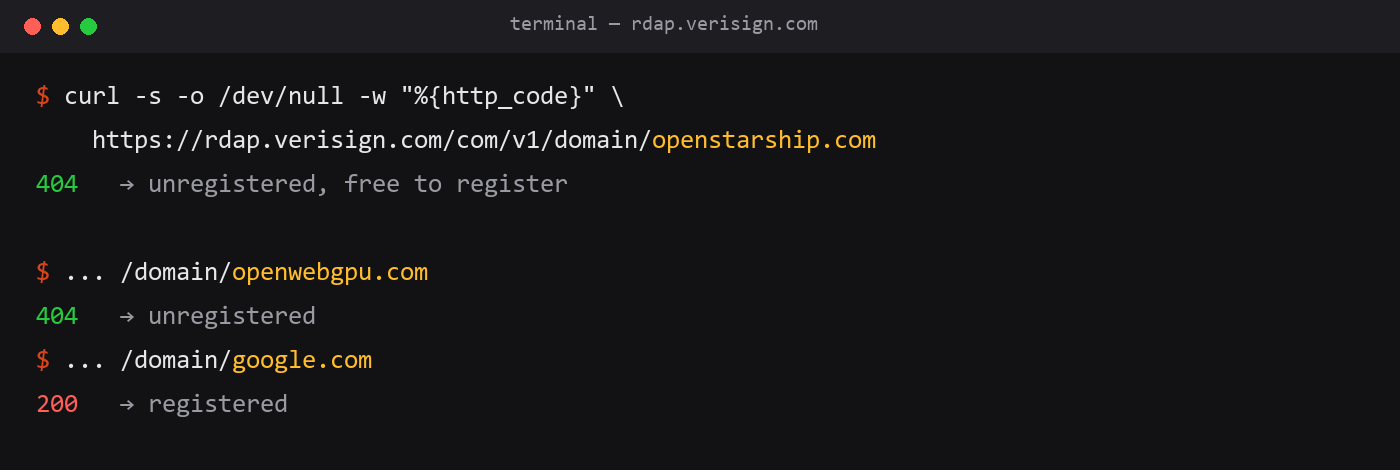
Go to the source instead. Every .com is managed by one registry, Verisign, and it runs a free public lookup service called RDAP. You can ask it directly whether a domain exists:
curl -s -o /dev/null -w "%{http_code}\n" https://rdap.verisign.com/com/v1/domain/openstarship.com- 404 means no such domain: it’s unregistered.
- 200 means it’s registered.
That’s the same answer every registrar ultimately relies on, with no upsell and no middleman. Loop over a list of ideas and you can check hundreds of names in a few minutes. Keep it to about one request per second so you don’t get rate-limited.
2. Hunt patterns, not single names
The biggest mistake is guessing names one at a time. Investors don’t do that; they pick a pattern that already sells, then look for the gaps.
Prefixes and suffixes that brands love include “get”, “try”, “use”, “go” and especially “open”.
“Open” is worth a closer look. It’s the word behind OpenAI and OpenEvidence ($450M raised this year), and the data backs up the hype. On NameBio, the largest public database of domain sales:
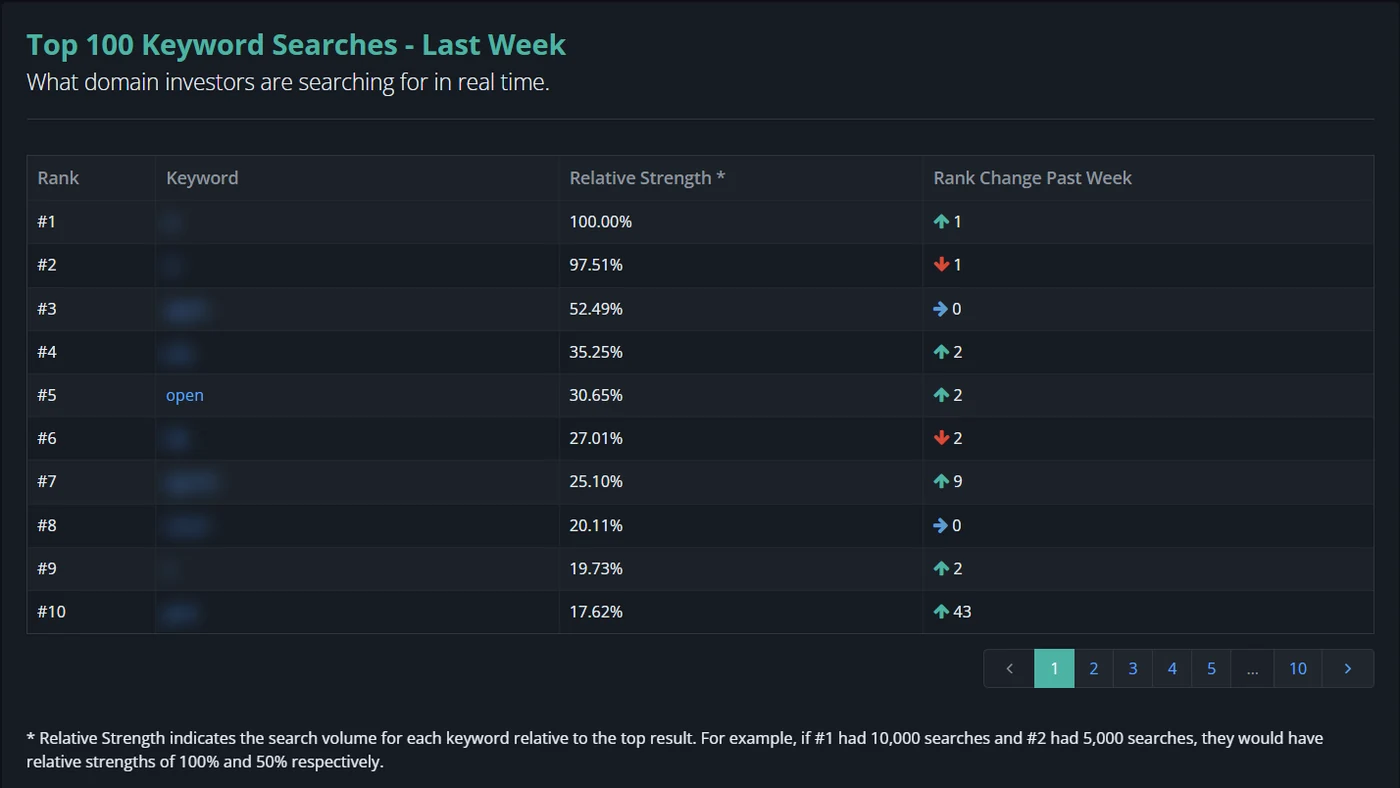
- “open” was the #5 most-searched keyword by domain investors last week.
- 1,961 “open” domains have recorded sales, worth $3.1M in total, with a top sale of $310K.
- Over the last 90 days, “open” names that sold at retail averaged $10,059.

You’d assume every open*.com is gone. It isn’t. Pair “open” with specific tech, science or everyday words and the registry keeps answering 404. These were all unregistered when I wrote this:
| Domain | Fits |
|---|---|
| openwebgpu.com | graphics / AI infra |
| openmonorepo.com | dev tooling |
| opencoroutine.com | developer tools |
| openstatefulset.com | Kubernetes tooling |
| openzkproof.com | crypto / privacy |
| openneutrino.com | science / research |
| openexoplanet.com | space / education |
| openstarship.com | anything ambitious |
Patterns don’t always work: trymonorepo.com is taken, while getcoroutine.com and usestatefulset.com were free. That’s why you check.
3. Use sales data, not gut feeling, to judge value
Before you fall in love with a name, look at what similar names actually sold for. NameBio lets you search by keyword and see real reported sales. For “open”, comparable sales include Openlivestream.com ($3,600, 2026), Openlaboratory.com ($3,200, 2026), OpenFair.com ($4,288) and OpenClient.com ($4,088).
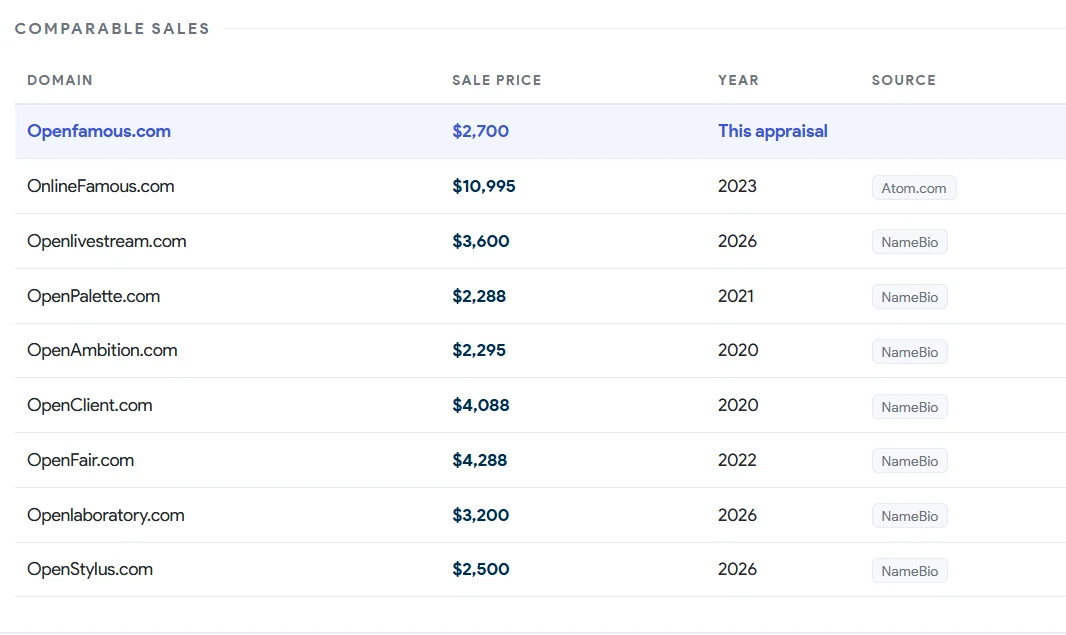
That’s your sanity check. If names like yours have sold in the low thousands, a $10 hand registration is a reasonable bet for a brand, and maybe for an investment.
4. Don’t trust a single appraisal tool
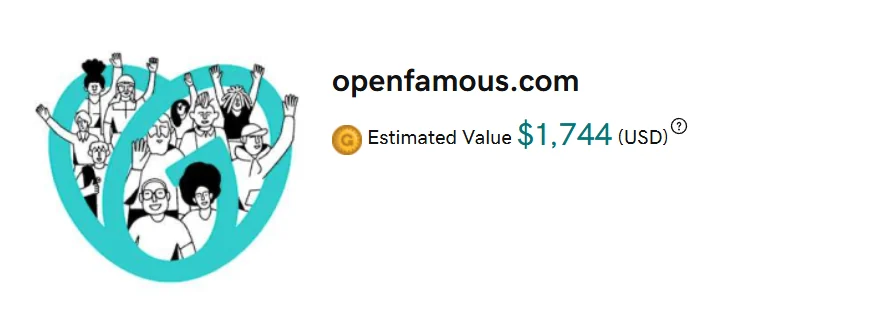
Automated appraisals are useful but wildly inconsistent. One name, openfamous.com (unregistered at the time of writing), came back as $1,744 on GoDaddy, $2,700 on another appraisal tool and $5,381 on Dynadot.
Another name from the same pattern, openanode.com, came back at $7,055 on a separate appraisal.
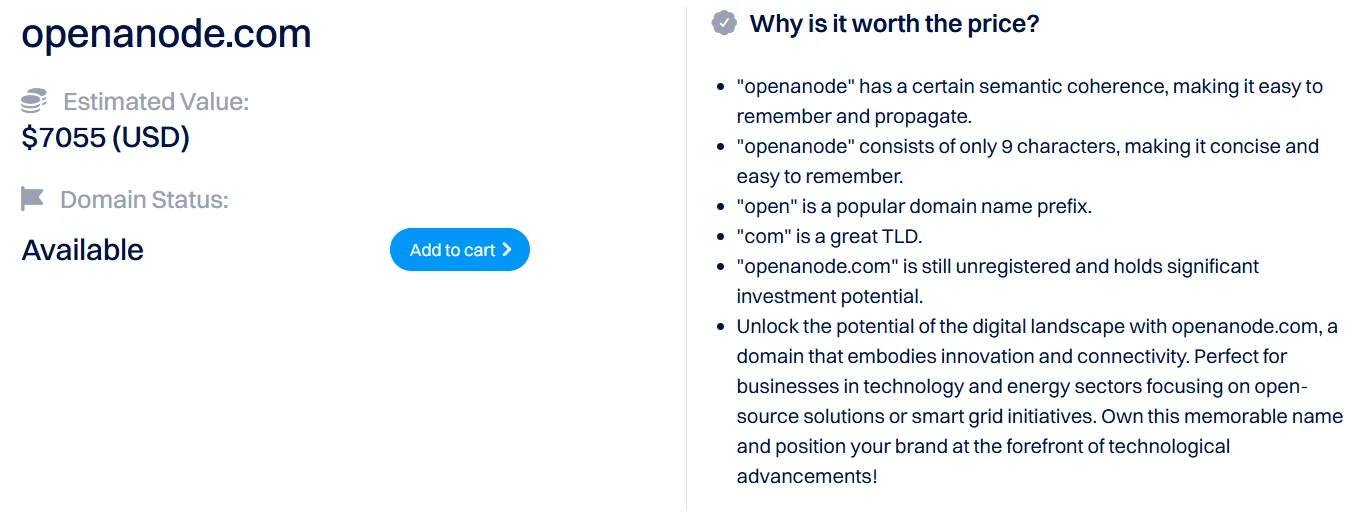
Use two or three tools and treat the range as a rough signal, not a price. Nobody can promise a resale, and most hand-registered domains never sell. Still, a consistent “thousands, not hundreds” across tools tells you something.
5. Re-check before you buy, because availability expires
This is the step everyone skips. A name that was free yesterday can be gone today. In one week of watching a list of open*.com names, one of them (openviewport.com) was registered by someone else mid-tracking.
If you build a shortlist, re-check it right before buying, ideally with the RDAP call from step 1.
The shortcut
If you’d rather not script all of this yourself, someone already has, for the “open” pattern at least.
attender.si does steps 1–5 continuously. It tracks thousands of open*.com names (4,664 available as I write this), checks each one against Verisign’s registry, re-checks every 3–6 hours, and drops names that get registered automatically. You get the result as a spreadsheet you can sort and filter, with the keyword, length and the last time each name was verified.
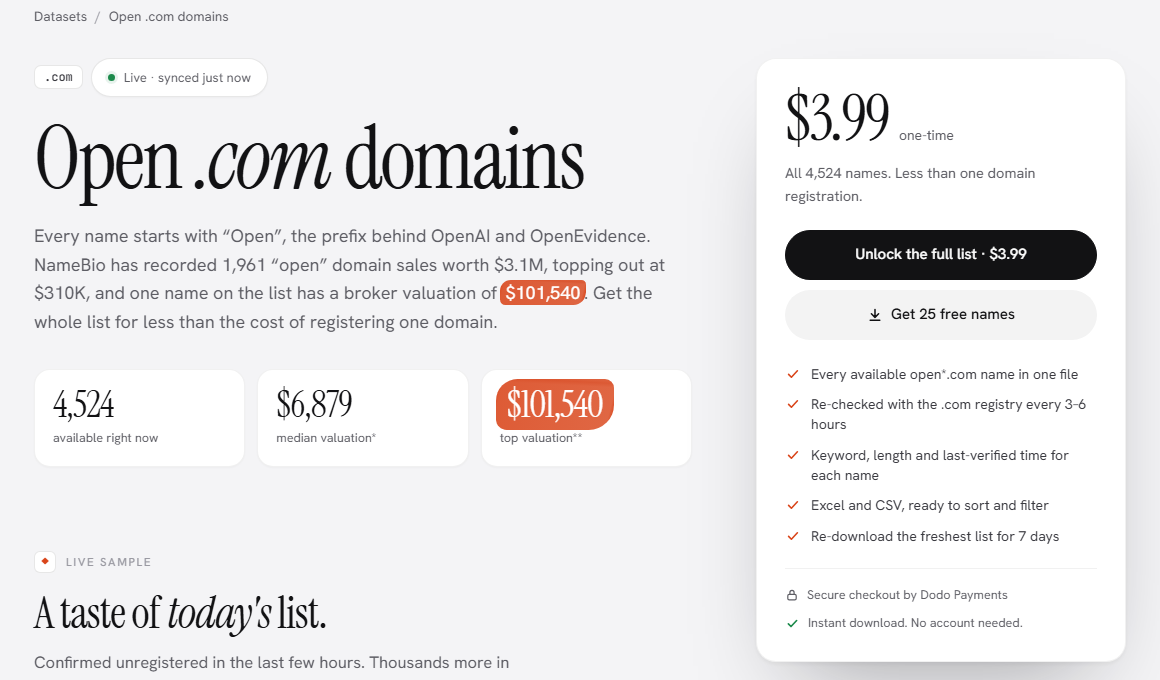
There’s a free 25-name sample with no sign-up or card, and the full list is $3.99. That’s less than the registration fee for the name you’ll end up buying. It’s a good way to see the pattern at scale before you start hunting on your own.
TL;DR
- Check availability at the source:
rdap.verisign.com, where 404 means free. - Hunt patterns that already sell (“open”, “get”, “use”) instead of guessing single names.
- Validate with real sales data (NameBio), not vibes.
- Cross-check appraisals across tools, and expect them to disagree.
- Re-check right before you buy.
The good .coms aren’t gone. They’re just not where everyone’s looking.
Disclosure: I built attender.si after doing this by hand one too many times. Appraisals are third-party estimates, not offers, and availability changes constantly, so always confirm at your registrar before buying.
◆Free sample
See the names before you pay.
25 real open*.com names from today’s list. Free. No card, no sign-up.